Call Today for Your FREE Consultation
630-355-7776
650 Diehl Road, Suite 117, Naperville, IL 60563


- Home
- Attorneys
- Practice Areas
- Testimonials
- Articles
- Stages of Divorce
- 10 Tips for Surviving Divorce
- Why Divorce Litigation is Sometimes Necessary
- What You Need to Know About Spousal Maintenance
- Trend toward “gender reversal” in marriage affects divorce
- Increase in boomer divorces and the issues faced by older couples
- Questions You Should Ask Your Prospective Divorce Attorney
- Working With Your Spouse to Divide Marital Debt
- Blog
- Contact Us
Alternative Dispute Resolution Options for Divorce in Illinois
 More than two million people get married every year, according to the CDC. And every year, almost seven hundred thousand people get divorced. How are all these people getting divorced when more than 90 percent of divorce cases are settled out of court?
Many people are surprised to learn that a courtroom is often not the best place to resolve a divorce case. Alternative dispute resolution, also known as ADR, offers a better solution. The general idea of ADR is to allow people a more cost-effective and less confrontational way to resolve their divorce.
Four main forms of ADR are available in Illinois for couples looking to file for divorce in 2026. You should always consult with a skilled Naperville, IL divorce attorney before you agree to enter any form of alternative dispute resolution.
What Are the Types of Alternative Dispute Resolution for Divorce?
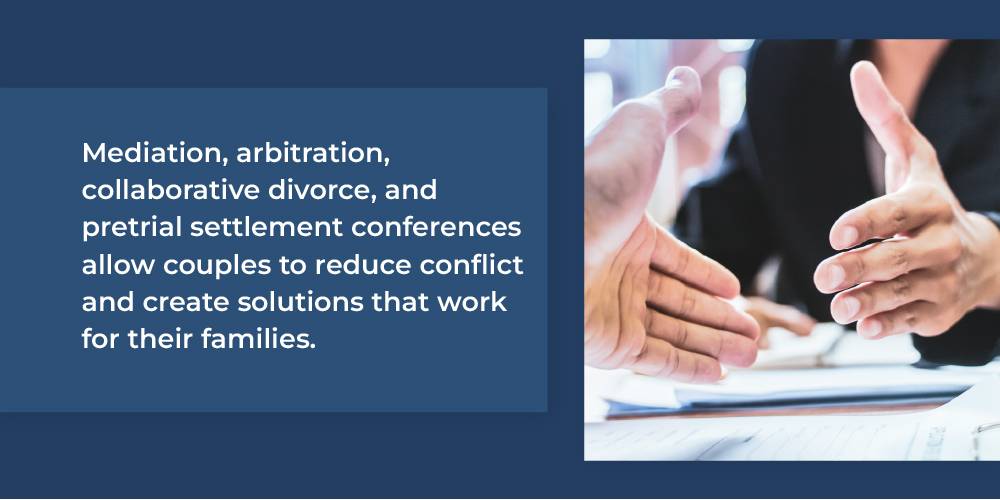
The main types of alternative dispute resolution available in Illinois divorces are mediation, arbitration, collaborative law, and pretrial settlement conferences. Each approach offers different benefits and drawbacks depending on your circumstances, the complexity of your case, and your relationship with your spouse.
Mediation
A mediator helps spouses communicate better so they can reach an agreement. The mediator is a neutral professional who helps identify issues, explore options, and negotiate solutions but does not make decisions or force any outcome.
Illinois law encourages mediation in divorce cases, and many Will County judges order couples to attempt mediation before trial. Mediation agreements can be converted to final orders once both parties sign off. You maintain complete control over the outcome and can proceed to trial if no agreement is reached.
Arbitration
An arbitrator has the power to make binding decisions on contested matters. Arbitration essentially acts the same as a trial, but happens in a private setting. You present evidence, call witnesses, and make arguments, and then the arbitrator issues a decision.
In Illinois, divorce arbitration is governed by the Illinois Uniform Arbitration Act at 710 ILCS 5. The arbitrator's decision can only be appealed under very limited circumstances, such as fraud or arbitrator misconduct.
Collaborative Law
In a collaborative divorce, everyone signs a participation agreement and must be represented by lawyers qualified to practice collaborative law. Collaborative divorces usually involve multiple meetings between spouses, attorneys, and other professionals.
These may include accountants, financial specialists, divorce coaches, and child specialists. A key feature of collaborative divorce is that if the process fails, the spouses must hire new lawyers. This motivates everyone to reach a settlement.
Pretrial Settlement Conference
These are meetings between spouses, their attorneys, and a judge to try to settle a case instead of going to trial. The judge hears both sides and discusses what they believe would be a reasonable settlement. This helps spouses make informed decisions about whether to settle or proceed to trial.
What Are the Top Benefits of Alternative Dispute Resolution?
Cost Savings
ADR methods are generally less expensive than traditional litigation, involving fewer court appearances and less attorney time for discovery, motion practice, and trial preparation. Mediation and collaborative meetings focus on productive problem-solving.
Faster Resolution
Mediation and collaborative divorce can often be completed within months, while litigation can take years. With ADR, you are also able to schedule sessions at convenient times rather than waiting for court dates.
Greater Control Over the Outcome
In traditional litigation, a judge decides on property division and child custody. In ADR, you have more control. You can create solutions that work for your situation rather than accepting a one-size-fits-all court order.
Confidentiality
Court proceedings become part of the public record, but ADR is generally confidential. Discussions remain private and only the final divorce decree is filed with the court.
Reduced Stress
Traditional litigation can make an already difficult process very stressful. ADR creates a calmer environment focused on problem-solving rather than the confrontational atmosphere of the courtroom.
Improved Communication
ADR requires constructive communication. Mediators and collaborative professionals teach techniques that help you express your needs and listen to your spouse's perspective. This benefits your post-divorce relationship, especially when co-parenting.
More Creative Solutions
ADR allows for creative solutions beyond standard court remedies. You might agree to keep the family home jointly until your youngest child graduates, or create unique parenting schedules that accommodate both parents' jobs.
Better Outcomes for Children
ADR protects children from conflict. Parents can create parenting plans tailored to their children's unique needs and school schedules.
Greater Personal Satisfaction
When you participate in making your divorce settlement, you are more likely to feel the outcome is fair. This leads to better compliance and lowers the odds that you’ll have to revisit an issue after divorce.
Protect Long-Term Relationships
ADR's collaborative approach preserves dignity and respect, making it possible to maintain a functional relationship after divorce. This matters when you must co-parent for years or continue working together in a family business.
Can You Use Multiple Forms of Alternative Dispute Resolution in a Divorce?
Many Naperville divorces use a combination of alternative dispute resolution methods. You might start with mediation to resolve most issues, then use arbitration to decide one or two specific disputes that you could not settle through mediation.
Do You Need an Attorney for Alternative Dispute Resolution?
For mediation, you are not required to have an attorney present during sessions, although you should absolutely have an attorney review any agreement before you sign it.
For arbitration, you should be represented by an attorney because the process is similar to a trial and the arbitrator's decision is binding.
For collaborative law, attorney representation is required under the Illinois Collaborative Process Act. Each spouse must have their own collaboratively trained attorney.
Contact a Naperville Divorce Attorney
Do you need help exploring your alternative dispute resolution options for a divorce in Illinois? Don’t wait – reach out to the Will County, IL divorce lawyers at Law Office of Ronald L. Hendrix, P.C. so you can get all of the help you need. You can call 630-355-7776 to schedule a free consultation and learn which ADR approach might work best for your situation. Over 30 years of experience.










650 Diehl Road, Suite 117, Naperville, IL 60563


Contact Our Firm
 The use of the Internet or this form for communication with the firm or any individual member of the firm does not establish an attorney-client relationship. Confidential or time-sensitive information should not be sent through this form.
I have read and understand the Disclaimer and Privacy Policy.